


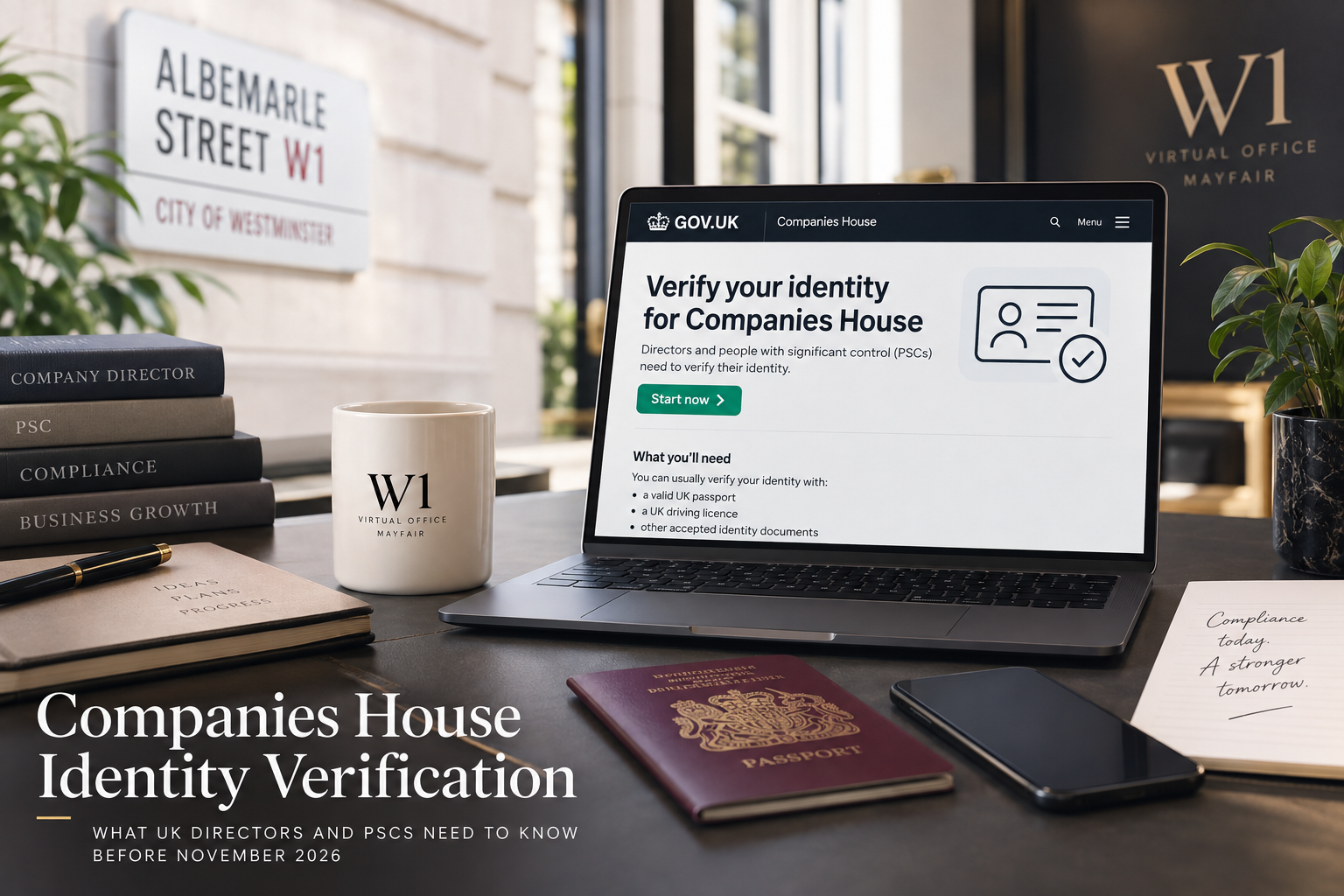
If you run a UK company, you have probably seen the phrase “Companies House identity verification” mentioned somewhere in the last year, whether that was an email from Companies House itself, a note from your accountant, or a headline about new rules for directors. It is a genuine change to how UK companies are administered, and it now affects almost everyone with a director’s role or significant control over a company.
The good news is that once you understand what is actually required, the process itself is straightforward. This guide sets out who needs to verify, when, and what to do with the result.
What Is Companies House Identity Verification?
Companies House identity verification is a legal requirement introduced under the Economic Crime and Corporate Transparency Act 2023. It requires directors, people with significant control (PSCs), and equivalent officers of UK companies to confirm who they are, so that the public register held by Companies House is more accurate and harder to abuse.
Voluntary verification opened in April 2025. From 18 November 2025, it became compulsory for new company incorporations and new appointments, with existing directors and PSCs being brought into the system gradually over a transition period. It is worth being precise here: there is no single date on which every existing director or PSC must have verified. Instead, each person’s deadline depends on their role and their company’s own filing dates, which is explained in the next section.
Who Needs to Verify Their Identity?
Directors
Anyone acting as a director of a UK company, including directors of overseas companies with a UK establishment, needs to verify their identity with Companies House.
People with Significant Control (PSCs)
If you are registered as a PSC, meaning you hold significant ownership or control over a company (typically through shares, voting rights, or the right to appoint and remove directors), you also need to verify.
If You Are Both a Director and a PSC
Many small business owners hold both roles at once. In this case, you only need to verify your identity once, but you must submit your personal code twice: once as a director, through your company’s confirmation statement, and once as a PSC, through a separate service. The two submissions have different timing, which is covered below.
When Do You Need to Verify?
New Companies and New Appointments
If you are incorporating a new company, or being appointed as a director of an existing one, verification now happens upfront. Your Companies House personal code needs to be provided as part of that filing.
Existing Directors
If you were already a director before 18 November 2025, you need to provide your personal code the next time your company files its confirmation statement. If you are a director of more than one company, this applies separately to each one.
PSCs and the 14-Day Window
PSC timing works differently. Every PSC has a 14-day window in which to submit their personal code, but when that window falls depends on your circumstances:
- If you are a PSC and a director of the same company, your 14-day window starts the day after your company’s confirmation statement date.
- If you are a PSC but not a director of that company, your 14-day window begins on the first day of your birth month. For example, someone born on 22 January has a window that opens on 1 January.
- If you become a PSC after 18 November 2025, your 14-day window starts from the date you are added to the Companies House register.
Because these dates are specific to each individual, the most reliable way to check your own deadline is to look up your company on the Companies House register, which now shows verification due dates for each role.
Overseas Companies
If your company is an overseas entity with a UK establishment, all directors need to have verified their identity by the anniversary of the UK establishment’s registration.
How to Verify Your Identity
There are two routes, and it is worth knowing that one of them costs nothing at all.
GOV.UK One Login (free). You can verify directly through the “Verify your identity for Companies House” service, using GOV.UK One Login. You will need a form of photo ID, such as a UK passport, a UK photocard driving licence, a non-UK passport with a biometric chip, or a UK biometric residence permit. Most people complete the process in ten to twenty minutes.
An Authorised Corporate Service Provider (ACSP). Alternatively, you can verify through an ACSP, such as an accountant or solicitor who is registered to carry out this service. This usually comes at a cost set by the provider, but can be convenient if you are already working with one for your company’s filings.
Either way, verification is a one-off process. You do not need to repeat it every year, and the same result is used to cover every role you hold across every company.
What Is a Companies House Personal Code?
Once you have successfully verified your identity, Companies House issues you an 11-character personal code. This code links your verified identity to your official record, and you will use it whenever it is needed for a filing, whether that is a confirmation statement as a director or a PSC submission.
Treat this code the way you would a National Insurance number or a Unique Taxpayer Reference: it is personal to you, and you should only share it with people you genuinely trust to file on your behalf, such as your accountant. Companies House has been explicit that sharing your code carelessly could allow someone else to use it to set up or control a company in your name, and you would be legally responsible for what follows.
What Happens After You Have Verified?
Once you have your personal code, there is nothing further to do until your company’s next relevant filing. At that point, whoever completes the confirmation statement (or PSC submission) enters your code alongside a statement confirming that verification has taken place. Companies House then links this to your record. From there, you can also check the register yourself to see the verification status and due dates for every role you hold.
What Happens If You Do Not Verify?
Non-compliance is a genuine legal issue, not a formality. If a director’s personal code is missing, a confirmation statement is unlikely to be accepted, which can hold up other filings your company needs to make. For PSCs, failing to provide a code within the required window may constitute an offence, potentially resulting in a financial penalty, and Companies House has indicated that unverified names may eventually be flagged on the public register. None of this is difficult to avoid, but it does mean verification is not something to leave until the last possible day.
Does It Cost Anything?
Verifying through GOV.UK One Login is entirely free. There is no charge from Companies House for this route. If you choose to verify through an ACSP instead, that provider may charge a fee for the service, but this is optional and reflects the convenience of using an existing adviser rather than a requirement from Companies House itself.
While You Are Reviewing Your Companies House Details
If you are already logging into Companies House to sort out identity verification, it is a sensible moment to glance over the rest of your company’s public record while you are there. Registered office addresses, in particular, are worth a second look. If yours is still a home address, or an old office you have since left, it is worth checking whether it is still the right choice for your business.
We provide a registered office address in Mayfair, London, along with a director’s service address and full mail handling, so that your company’s public-facing details reflect your business properly. It is a small, practical thing to tidy up while your Companies House record is already open in front of you.
Frequently Asked Questions
Do I need to verify my identity every year? No. Verification is a one-off process. Once you have your personal code, it applies to every role you hold, and you only need to submit it again when a specific filing requires it.
What ID do I need for GOV.UK One Login verification? A UK passport, UK photocard driving licence, non-UK passport with a biometric chip, UK biometric residence permit, UK biometric residence card, or UK Frontier Worker permit will all work.
I am a director of several companies. Do I need to verify separately for each one? You only verify your identity once, but you need to provide your personal code separately for each company, at that company’s next confirmation statement.
What if I am both a director and a PSC of the same company? You still only verify once, but you must submit your personal code twice: as a director through the confirmation statement, and as a PSC through the separate PSC service, within your 14-day window.
Can my accountant do this for me? Yes, if they are registered as an Authorised Corporate Service Provider. They can complete the verification on your behalf, usually for a fee.
What happens if I miss my PSC 14-day window? You may be committing an offence, which can carry a financial penalty. It is worth checking your due date on the Companies House register in good time rather than waiting to be reminded.
Where can I check my own verification deadline? The Companies House register now displays identity verification due dates for each role you hold, so you can check your own company’s page directly.
If you would like to talk through your company’s registered office address while you are getting your Companies House details in order, get in touch with our team or read more about our registered office service.